

How to Start Homeschooling Your Middle Schooler: What I Wish I’d Known Before We Started
This post may contain affiliate links, which means I may earn a small commission if you purchase through my links at no extra cost to you. I only share products I genuinely use or truly recommend.
Okay, I think we’re actually going to homeschool. Now what in the world am I supposed to do?
I researched everything. I bought good curriculum. I made plans. And then my actual child showed up, and I started discovering what actually worked for him. And it wasn’t what I had planned.
These are the lessons I’ve learned (so far) along the way.
In this post
- Before you buy anything, find out what your state requires
- Think about whether your child may return to public school
- Don’t order an entire homeschool before you’ve figured out how your child learns
- Expect an adjustment period
- You do not have to do all the things
- Give yourself permission to change curriculum
- Textbooks aren’t the only way to learn
- Look for learning outside your curriculum
- Expect boredom—but investigate it
- Build your homeschool around your actual child
1. Before you buy anything, find out what your state requires.
This absolutely needs to be your first step. Homeschool laws vary considerably by state—everything from notification requirements and required subjects to number of days/hours, testing/evaluations, recordkeeping, etc. HSLDA (Home School Legal Defense Association) has a state-by-state legal map that includes withdrawal information and requirements.
Check your state Department of Education rather than relying solely on someone’s blog or social media post. Requirements can change, and you want to make sure you have the most up-to-date information. This will help you determine what you’re required to teach—and it may not be the same as what’s being taught in public school.
Before you start buying curriculum
Once you’ve checked your state’s homeschool requirements, make a simple list of the subjects you actually need to cover. Start there. You can always add electives, enrichment, extra classes, and all the fun stuff later. (And believe me, you’ll find plenty of things you want to add.)
2. Think about whether your child may return to public school.
A family who is certain they’re homeschooling through graduation may make different curriculum decisions than a family who thinks, We’re trying this for sixth grade and may go back for seventh.
Check your state’s academic standards and, if returning to public school is a realistic possibility, look at your local district’s course sequence too. This isn’t to say you should recreate public school at home. But you don’t want to discover later that your child is missing something that makes reentry more difficult.
This becomes increasingly important as middle school approaches high school and courses begin affecting placement and prerequisites.
In my case, it’s possible my current sixth grader may go back to public school for high school. To account for that possibility, I’ve checked our state’s standards and course sequence to make sure we’ll cover what he needs before entering ninth grade.
This is especially true for math. Other subjects can be more forgiving, but having the necessary knowledge to go into pre-algebra or algebra should be a consideration.
Start here: before you buy curriculum
✓ Find your state’s homeschool requirements.
✓ Find your state’s academic standards.
✓ Check your local district’s course sequence if returning to public school is a possibility.
✓ Write down the core subjects you need to cover.
✓ Then start looking at curriculum.
3. Don’t order an entire homeschool before you’ve figured out how your child learns.
I knew going in that I wanted less online curriculum. My son has myopia, so I wanted to keep him off a device like a computer or iPad as much as possible (part of the reason we decided to homeschool!). He also has ADHD, so attention considerations were at the forefront of my curriculum decisions.
I had to really observe how he retained information. I paid attention to his homework, how his teacher was presenting and testing the material, his comprehension, his frustration level, etc. It can be difficult piecing this together, but you’d be surprised what you can learn about your child.
I also learned that choosing curriculum based on his needs didn’t mean I’d get everything right the first time. Something that looked perfect on paper could still fall flat when we actually used it.
I’ve learned that my son retains a surprising amount through conversation while he’s playing with fidget toys, that shorter lessons generally work better for him, and that sometimes changing how we do an assignment makes more difference than changing the assignment itself.
For example, we rarely do written worksheets. I typically use worksheet questions orally, which often leads to more conversation.
Figure out your child’s learning preferences and needs.
Does he retain more when you read together?
Does she need to move?
Does he shut down over a page with 40 repetitive problems?
Does she love video instruction?
Does he hate it?
Does he need something to do with his hands while listening?
Does he learn better through discussion than worksheets?
This is particularly relevant for ADHD. CDC guidance recommends things such as shorter/non-repetitive assignments, movement and breaks, reducing distractions, organizational supports, and observing what actually helps a child learn. Take a look at this CDC article to take a deeper dive.
Homeschool gives you the freedom to actually use that information.
4. Expect an adjustment period.
This is especially true if your child is coming out of public school.
Don’t expect to announce We’re homeschooling! and suddenly everyone sits down at the table, smiling and ready to go.
It’ll be messy. There will be frustration—for both you and your child. And that’s okay. It’s an adjustment, and it takes time.
I continue to tell everyone my son and I are still figuring each other out. It’s been quite the journey. We’ve had to figure out how long school should actually take, when he focuses best, how much work is too much, and when I need to push him versus when I need to back off.

Even something as simple as what time to start school took some trial and error. We tried early morning, midday, and afternoon before realizing that earlier is definitely better for him. Going too far past lunchtime is a no in our house.
And even then, every day is different. Some mornings he sits down at the kitchen table without a complaint. Other days—especially if he didn’t sleep well—the complaints seem endless.
We’ve had to adjust his workload too. In the beginning, I followed the schedule recommended by our math curriculum, but it was too much and created some meltdowns. I backed off, assigned fewer problems, and slowed down. Now that we’ve settled into homeschooling, I’ve actually been able to increase the pace again with fewer complaints.
Through all that trial and error, I’ve learned so much about my son. He’s an intelligent, curious kid, and I’ve loved getting to see more of that outside the classroom.
Give yourself time to figure these things out too.
You may need to start with a lighter workload and build from there. Pay attention to when your child focuses best and how long he or she can reasonably work before school starts becoming counterproductive. Some days may look different from others. You can be flexible.
And if your child is coming from traditional school, give yourself permission to question which parts of “school” you actually want to bring home with you. There may be routines or methods that worked really well for your child and are worth keeping. There may be others you’re doing simply because that’s what school has always looked like.
You don’t have to know the answer to all of that on your first day. Figuring it out is part of the adjustment.
5. You do not have to do all the things.
You’ll want to do it all. Believe me, you will. Homeschooling is exciting, and once you start researching all the possibilities and all those pretty curriculums, you’re going to want it all.
Curriculum companies show you all these beautiful extras, social media shows you elaborate homeschool rooms and projects, homeschool groups have classes and field trips, and suddenly you’ve recreated the overscheduled environment you were trying to escape.
I did this. I added so many extras to our core curriculum—poetry, typing, cursive, etc. And I was quickly in over my head.
What actually matters here?
Homeschool freedom doesn’t mean you finally have time to do everything. It means you have the freedom to decide what’s worth doing.
Start with the essentials. Then add things. Not the reverse.
6. Give yourself permission to change curriculum.
I bought the pretty curriculum, the one recommended in every Facebook homeschool group. Four weeks into the school year, I knew it wasn’t working.
A curriculum can be excellent and still not work for your child.
And there’s a huge distinction between:
“He doesn’t like schoolwork.”
and
“This particular way of teaching this subject isn’t working.”
Middle schoolers are old enough to have opinions about their education. You don’t have to let them dictate the curriculum, but you can ask:
What don’t you like about this?
Is it boring because you already know it?
Is it too difficult?
Is there too much reading?
Would you rather listen to me read it?
Would a documentary help?
That turns curriculum selection into an ongoing process rather than a decision you make in July and endure until May.
I didn’t completely scrap the curriculum, but I did start presenting it in a different way. When that still wasn’t hitting the spot, I started rethinking it completely. Now we use that particular curriculum as a reference rather than the entire spine.
7. Textbooks aren’t the only way to learn.
My kid can only take so much textbook.
Instead of reading a textbook chapter and answering comprehension questions, think outside the box.
• Read a short primary source and notebook about it.
• Watch a documentary and record three interesting facts.
• Draw and label a scientific concept.
• Create a timeline.
• Map an event.
• Research a question that came up during the lesson.
• Narrate what he learned.
• Create a one-page notebook spread about a topic.
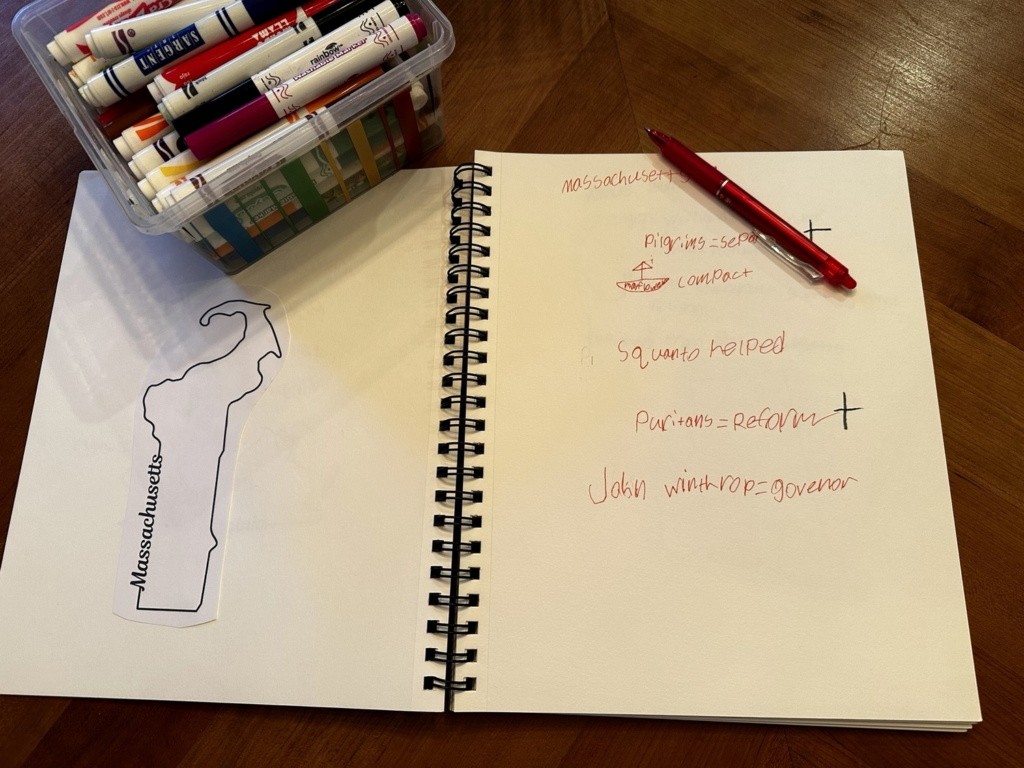
For history, we ditched the textbook. Some days we’ll read a passage, and he’ll record interesting facts in his history notebook.
For the thirteen colonies, he created a two-page spread on each colony, and every time we read something about that colony that sticks out or seems interesting, he scribbles it in his notebook.
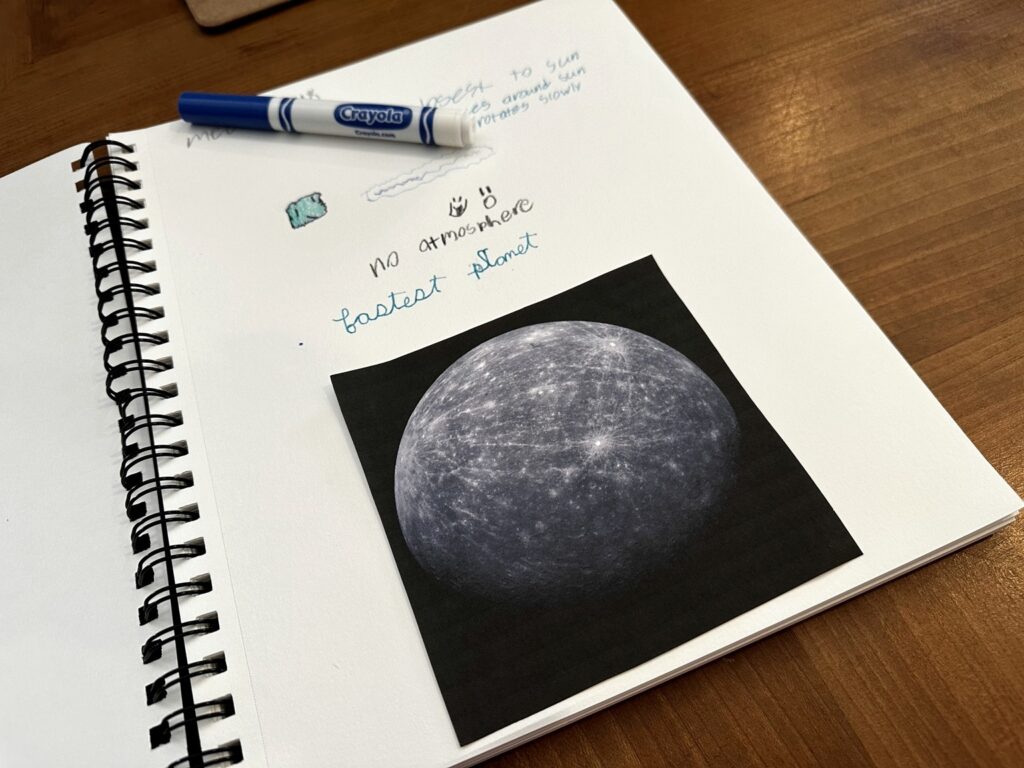
We use this same idea for Astronomy. He writes, draws, paints, etc. in his Astronomy notebook—whatever weird facts he finds interesting.
Sneak writing into real life.
My husband works out of town a few days during the week, so my son emails him about his day and anything he found interesting.
What did you learn today that Dad would think was cool? What happened today? Tell him about it.
Now he’s practicing summarizing, choosing relevant information, sentence construction, communication, typing, and writing for an actual audience. He loves doing this and often incorporates goofy details to see what his dad will reply back.
That’s school.
And it’s arguably a much more authentic writing assignment than “Write five sentences about what you learned today.”
8. Look for learning outside your curriculum.
Middle school is such a fun age. They’re curious, especially about their passions, and old enough to dig into the really cool stuff.
My son chose Astronomy for science for his sixth-grade year, and we’re having a lot of fun with it. We have a textbook, but we read the important parts and skip the fluff.
Think outside the box. Field trips, experiments, games, documentaries, etc.
I share an interesting fact every day (we call them Wait…What? facts) for Astronomy because that’s his favorite subject. Recently, an asteroid entered Earth’s atmosphere, and we spent some time talking about that. It had nothing to do with the lesson I planned for Astronomy that day, but we fell down the rabbit hole.
You don’t have to say, We can’t learn about that because today’s lesson says we’re studying something else.
That rabbit hole is learning. Embrace it.
Don’t become so committed to finishing school that you interrupt your child’s education.
The best thing you can foster is a love of learning, and they aren’t going to get that if you’re so strict about sticking with your curriculum that you overlook their natural curiosity.
9. Expect boredom—but investigate it.
Boredom isn’t necessarily a bad thing. Kids are used to a lot of stimulation, and school isn’t always stimulating. Anticipate the boredom, but do some digging into why it’s happening. If there’s a legitimate reason, determine whether there’s a change you can make to alleviate it.
I’m not saying you should make every single subject so fun and engaging that your child is never bored—that’s impossible.
It’s really okay for kids to be bored. Some things in life are boring, and they have to learn to push through and get the work done.
But investigate to figure out the why.
Sometimes kids are bored because something is repetitive. Mix it up a little. Small changes really can make a difference.
Sometimes it’s too easy. If they’ve already grasped a concept, move on to the next. You don’t have to do every single problem in every single lesson if your child already knows it.
Sometimes it’s too difficult. I’ve had this happen with math, and I slowed down the pace.
Sometimes the delivery is boring. This was the case with our history curriculum (I even found it boring!), so I made some adjustments.
Sometimes they’re eleven and simply don’t feel like doing math. 😂 This still happens…
The goal isn’t “My homeschooled child is never bored.”
It’s learning to recognize the difference.
10. Build your homeschool around your actual child.
No child is the same, so don’t think you’ve done something wrong if you’re hitting some serious frustration with the curriculum everyone is raving about or the schedule your best friend follows for her own children is causing meltdowns in your home.
The beauty of homeschool is being able to tailor it to your own child’s needs, not someone else’s.
I had a lot to consider when I was planning our homeschool—myopia and screen use, ADHD and focusing, frustration tolerance, my child’s interests, and what causes school to drag unnecessarily.
I researched everything before we started homeschooling. I scoured Facebook posts, read curriculum reviews, made schedules, planned subjects, and tried to anticipate every problem we might encounter.
What I couldn’t plan for was the most important part: actually homeschooling my child.
That’s the part we’re still figuring out.
I’ve changed curriculum, dropped things I thought we’d do, added things I never would have considered “school” before, and learned to pay more attention to whether he’s actually learning than whether we’re following my original plan.
If you’re just starting out, you don’t have to have your entire homeschool figured out on the first day. As a matter of fact, I’d encourage you not to go too far with that because you will need to change things.
Know your state’s requirements. Cover the things your child needs to learn. Pay attention to the child in front of you. And give yourself permission to change course when something isn’t working.
Your homeschool probably won’t look exactly like the one you planned.
It may end up being better.
